 Cape
Cape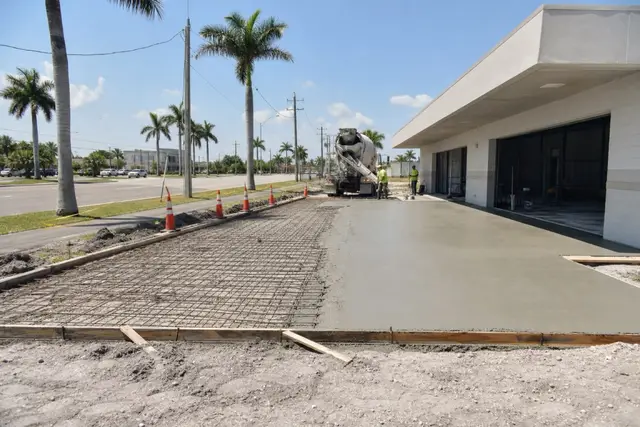
Cape Driveway Pros pairs Cape Coral homeowners with a local concrete contractor who quotes and handles commercial concrete driveways across Cape Coral and its Lee County neighbors.
A commercial driveway lives a harder life than anything residential: box trucks daily, the occasional semi at the loading door, garbage service twice a week, and delivery vans cutting the same wheel path a hundred times a month. Concrete earns its keep in exactly this duty — where asphalt ruts and alligator-cracks under Florida heat and point loads, a properly designed slab holds its grade for decades of traffic.
Design starts with the axle, not the square footage. Drive lanes and aprons for medium trucks run six inches with rebar or heavy mesh over a compacted, proof-rolled base; dock approaches and dumpster runs go thicker. Joint layout gets engineered around the traffic path so wheels cross joints at doweled, load-transferring lines rather than free edges — the detail that separates a 30-year commercial slab from a 10-year one.
Business reality shapes the schedule as much as the spec. Pours get staged so the shop never fully closes: half the apron this week, half the next, early-morning pours ahead of opening hours, high-early-strength mixes where a lane must reopen in days. Commercial quotes itemize phasing alongside thickness and steel, because downtime is a cost line even when concrete isn't.
Aprons, right-of-way, and the county's growth math
Where a commercial drive meets a public road, it becomes an 'approach' in permitting language, and the standards tighten: radii sized for the design vehicle, sight lines, drainage structures that preserve the roadside flow. Inside Cape Coral the city checks the connection; across the broader metro, Lee County Community Development handles it — and with the county's population having grown past three-quarters of a million, commercial corridors keep resurfacing and re-permitting continuously.
Stormwater is the second gatekeeper. Commercial impervious area triggers drainage requirements residential work never sees, and on this coast the receiving system is ultimately the canal network and the estuaries the South Florida Water Management District manages. A contractor fluent in those submittals keeps a two-week apron job from becoming a two-month one.
Specifying for trucks, heat, and the long haul
Commercial mix design here optimizes for different enemies than up north: no freeze cycles, but relentless heat during placement, heavy wheel abrasion, and fuel or hydraulic drips at loading zones. Higher-strength mixes, hard steel-troweled or heavy-broom surfaces by duty area, and joint sealing against fuel intrusion are the standard kit; the pavement engineering behind it is core material at the American Concrete Institute and the Portland Cement Association.
Hot-weather placement discipline scales up with the pour: commercial slabs go down at dawn, evaporation gets managed with retarders and fog when the wind runs dry, and curing compound hits the surface on schedule because a 4,000-square-foot pour can't be babied by hose the way a house driveway can. The crews that do this well treat the thermometer as part of the spec.
Worth a deeper look
Before you pour
Concrete or asphalt for a commercial lot in Florida?
Asphalt costs less on day one; concrete usually costs less by year ten. Florida heat softens asphalt exactly where trucks turn and dumpsters sit, which is why so many local lots are asphalt fields with concrete pads at the abuse points. Full-concrete drives make sense where truck traffic is constant.
How thick does a truck apron need to be?
Six inches reinforced is the working floor for medium-duty truck traffic over a compacted base, stepping to seven or eight where semis and roll-off trucks concentrate loads. The honest answer comes from the design vehicle and soil verification — which is what the site visit establishes before numbers go on paper.
Can you pour without closing my business?
That's the default plan, not a special request. Phased pours, temporary access routing, overnight and dawn placements, and high-early mixes that take traffic in days are all standard tools. The quote includes a phasing sketch so you can see which doors stay open on which days.
How soon can trucks use a new apron?
With conventional mix, plan on seven days before heavy trucks; high-early-strength designs can responsibly cut that to two or three for lanes that must reopen. Cars can typically return sooner than trucks. The reopening dates get written into the schedule, not left to optimism.
Who handles the permits on commercial work?
The contractor, as part of the job — connection permits for the approach, stormwater compliance where triggered, and the inspections each requires. What the owner provides is site information and sign-offs. If a bidder leaves permitting as 'by others,' read that as a schedule risk being handed to you.