 Cape
Cape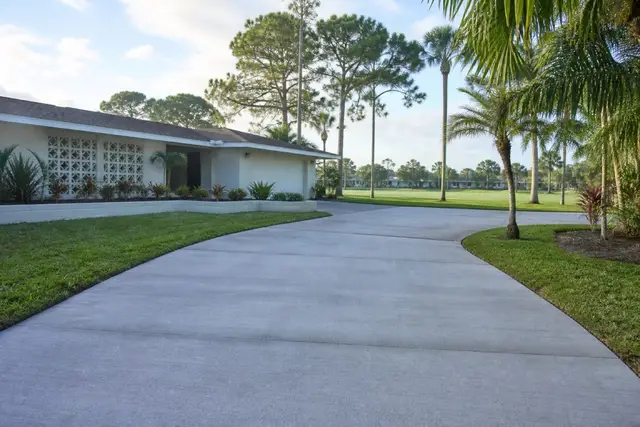
Cape Driveway Pros pairs Whiskey Creek homeowners with a local concrete contractor who covers Whiskey Creek for new driveways, tear-out replacements, repairs, and decorative concrete.
Whiskey Creek is a time capsule with a golf course through it: 4,842 residents at the 2020 Census in a deed-restricted community of low-slung 1960s and 70s ranches arranged around the fairways off McGregor Boulevard. The architecture is genuine mid-century Florida — breeze-block accents, carports converted to garages, terrazzo inside — and the driveways are frequently original equipment, poured when the houses were.
Fifty-plus years is a full career for a residential slab, and Whiskey Creek's are retiring in waves: sun-chalked surfaces, joints eroded to gravel, panels cracked by decades of settling and the occasional slash-pine root. Replacement is the neighborhood's dominant driveway project, and it comes with a design question worth taking seriously — a bright-white modern pour can look wrong against a 1965 elevation, while a softer gray broom finish with period-appropriate joint lines looks like it was always there.
The community's civic association maintains deed restrictions that keep the neighborhood coherent, so driveway changes get a compatibility look. Ground conditions are mature and predictable: long-settled native sand under established lawns, mature palms and pines whose roots have had decades to wander. Cape Driveway Pros connects Whiskey Creek homeowners with a contractor who treats those originals with the respect a five-decade slab has earned.
Retiring a 1965 driveway gracefully
Original Whiskey Creek slabs were poured thin by modern standards — three and a half inches was common, unreinforced, on lightly prepared ground — and they've done astonishingly well considering. Their replacements get the current spec: four inches, fiber or steel, compacted base, joints sawn on schedule per the practice collected by the Portland Cement Association. The upgrade is invisible from the street, which is exactly the point in a neighborhood this consistent.
The trees deserve pre-planning here more than most places. Sixty-year-old slash pines and mature palms sit close to many drives, and their root zones don't appreciate excavation surprises; the county's horticulture help desk at the UF/IFAS Lee County extension is the free local authority on which roots can be worked around and which trees will punish the attempt.
Deed restrictions as a design ally
Whiskey Creek's restrictions exist to keep the neighborhood reading as one composition, and driveway projects that embrace that — finishes in quiet grays, aprons matching the established curb geometry, no lot-line-to-lot-line paving — sail through while making the house worth more. Lee County handles the underlying permits through Community Development, since the community is unincorporated; the association layer is about appearance, and it rewards contractors who show up with drawings.
Golf-course lots add one quiet consideration: drainage toward the fairways is engineered and shouldn't be casually redirected by a regraded driveway. Keeping the lot's flow paths intact — the same sheet-flow discipline the region's water managers at the South Florida Water Management District apply at scale — keeps both the course superintendent and your own foundation happy.
Worth a deeper look
Before you pour
Should I match my new driveway to the neighborhood's originals?
It usually pays to. A standard-gray broom finish with joint lines echoing the 1960s originals keeps the streetscape coherent and satisfies the deed-restriction approval easily. Save bold decorative statements for backyards here — the front yard's value is its consistency.
My original slab has terrazzo-like shell showing — can that look be recreated?
Yes — exposed shell-aggregate finishes are the modern descendant of that old Florida look, and they suit mid-century elevations beautifully. It prices above plain broom but reads absolutely correct on a Whiskey Creek ranch. Sample panels settle the choice.
How disruptive is a full replacement on an occupied street?
A few days of driveway-less parking and one morning of concrete trucks. Crews here stage tear-out and pour tightly, protect the swale and neighbors' aprons, and leave the street broom-clean. The association's contractor courtesy rules get followed as a matter of course.
Are tree roots under my driveway a reason to remove the tree?
Rarely. Most root-cracked Whiskey Creek slabs can be replaced with root-aware design — slight realignment, thickened edges, root barriers where appropriate — keeping the mature canopy that makes these blocks feel established. Removal is the last resort, not the default.
What will replacing a typical Whiskey Creek driveway cost?
Most of these drives are modest in area, so replacements commonly land in the middle four figures — tear-out, base, and repour itemized. The free quote measures yours specifically; golf-lot access and tree considerations are the variables that move the number.