 Cape
Cape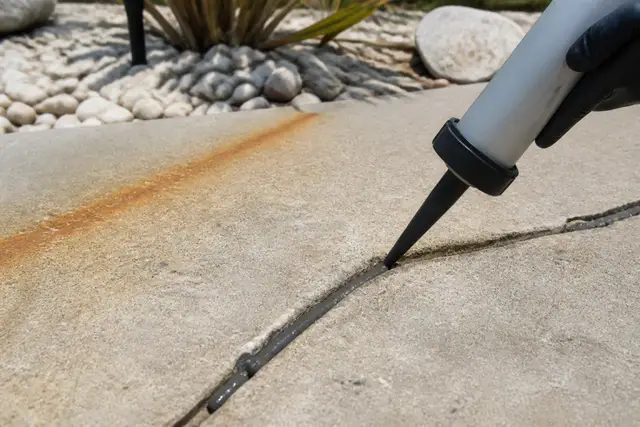
Cape Driveway Pros pairs Cape Coral homeowners with a local concrete contractor who quotes and handles concrete driveway repair across Cape Coral and its Lee County neighbors.
Not every ugly driveway is a dead driveway. A Cape Coral slab with a couple of working cracks, some popcorn spalling near the sprinkler heads, or one settled corner can often be repaired for a small fraction of tear-out money — provided the base under it hasn't quit. The repair-versus-replace call is the whole game, and it's why a quote here starts with someone probing the subgrade instead of just measuring the damage.
The Cape's damage patterns are distinctive. Rust-orange staining tracks wherever well-water irrigation hits the concrete. Spalling concentrates near canal-side lots where salt spray and sprinkler chlorides chew the surface paste. And straight-line cracks radiate from re-entrant corners where the original builder skipped a control joint. Each has a matched fix: routing and flexible sealant for moving cracks, polymer-modified patching for spalls, cleaning and sealing for stains.
Settled panels get a different conversation. Where a section has dropped because fill washed out beneath it — common along utility trenches and near seawalls — slab jacking or localized base rebuild can bring it back to grade. Pricing scales with the fix, from a few hundred dollars for crack work to four figures for lifting, and the itemized quote makes plain which repairs are worth it and which dollars belong in the replacement fund.
Why cracks behave differently on sand than on clay
Driveway advice written for the rest of the country assumes clay: soil that swells, shrinks, and heaves slabs seasonally. Southwest Florida's deep sands — the character of the state's soils is laid out in UF/IFAS's Agricultural Soils of Florida — don't do that. When a Cape slab cracks and moves, the usual culprit is erosion or a compaction void, not expansion. Water found a path under the concrete and took sand with it.
That distinction changes the repair. Sealing the crack matters less for looks and more for shutting off the water supply to the void below; fixing the drainage that fed the washout — a downspout, a sprinkler leak, an apron pitched wrong — is the half of the job that makes the repair stick. Guidance from the Portland Cement Association treats moisture control as the core of concrete maintenance for exactly this reason.
Salt, sprinklers, and the surface repairs that last
On canal-adjacent lots, chloride exposure isn't a northern road-salt story — it drifts in on the breeze and rides in irrigation drawn from brackish-influenced wells. Over years it attacks the cement paste at the surface and any steel near it. Repairs in that environment favor polymer-modified mortars that bond tight and shed water, followed by a penetrating sealer; the mix-design science behind chloride resistance is the daily business of the National Ready Mixed Concrete Association's member producers.
Timing helps too. The local climate record shows the dry season, roughly November through May, delivering week after week of low-humidity days — ideal windows for patch materials and sealers that want dry concrete and a rain-free cure. A repair scheduled in February simply has better odds than the same repair raced against a July thunderstorm.
Worth a deeper look
Before you pour
Is a cracked driveway dangerous or just ugly?
Hairline cracks are cosmetic. The ones worth prompt attention are vertical offsets that become trip hazards, corners breaking loose near where people walk, and any crack that's visibly widening season over season — that last one means the base underneath is still moving and the repair should address why.
Can rust stains from irrigation be removed?
Mostly, yes. Iron in well water leaves the classic orange ribbon wherever sprinklers overshoot, and oxalic-acid-based cleaners lift the bulk of it. Keeping it gone means adjusting the sprinkler arc or filtering the iron; otherwise the stain redraws itself within a season or two.
What does crack repair actually cost?
Routing and sealing a handful of cracks typically lands in the low hundreds. Spall patching prices by area, and panel lifting by how far things have sunk. It's the cheapest category of concrete work on this site — and the quote will say plainly when a slab is too far gone to be worth it.
Will repaired cracks show?
Yes — an honest answer. Sealed cracks read as neat dark lines, and patches cure to a slightly different gray than sixty-year-old sun-bleached concrete. If uniform appearance matters, repair the structure first and add a resurfacing overlay for looks; that combination is still far cheaper than replacement.
My driveway sank near the seawall — is that serious?
Treat it seriously. Settlement concentrated on the canal side can mean fill migrating toward or under the seawall, and the driveway is the visible symptom. Have both looked at together: lifting the slab without addressing the path the sand is taking just schedules a repeat.