 Cape
Cape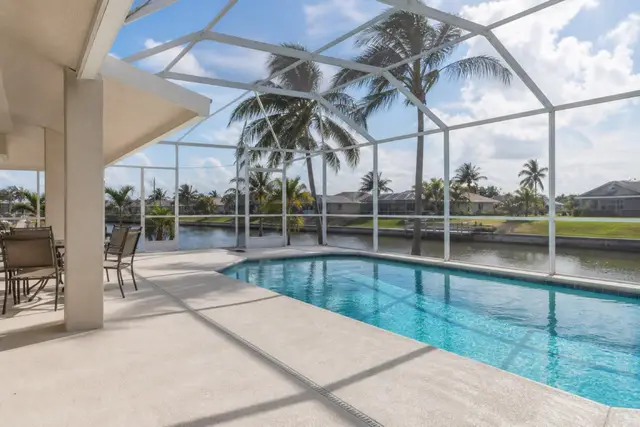
Cape Driveway Pros pairs Cape Coral homeowners with a local concrete contractor who quotes and handles concrete patios & pool decks across Cape Coral and its Lee County neighbors.
In Cape Coral the backyard is the house: a pool inside a screened cage, a covered lanai off the sliders, and — on the lucky half of the city — a canal and seawall past the screen. Concrete is the floor of that whole world. Pool-deck work here means pouring or renewing the slab around the water, setting deck drains so cage-cleaning water and storm blow-in leave on schedule, and finishing with textures that stay walkable under an August sun.
Surface temperature is the design decision owners feel every day. Light colors reflect; textured finishes carry less contact area than smooth ones; and cool-deck-style knockdown toppings were invented for exactly this climate. A pale shell-toned knockdown over a sound slab keeps bare feet comfortable in ways a plain gray troweled deck never will — and it's equally available as a renovation topping on decks that already exist.
The engineering under the fun matters too. Decks pitch away from the pool shell and toward drains at about a quarter inch per foot; isolation joints separate deck from coping and house slab so nothing cracks anything else; and on canal lots, the pour respects the seawall's drainage path rather than loading new weight against it. Patio and deck projects quote per square foot with texture and drains itemized.
Salt pools, chlorine, and choosing surfaces that cope
A large share of Cape pools now run salt chlorine generators, which means the deck lives with mild saltwater splash year-round — gentler than ocean spray, but constant. Dense concrete, maintained sealer, and rinse-downs after heavy splash keep salt crystallization from slowly opening the surface; the durability chemistry is the same chloride story the American Concrete Institute documents for marine-adjacent flatwork. Textured toppings add sacrificial thickness where it helps most.
Around the cage line, the deck also anchors the enclosure itself — screen-cage posts land on the slab edge, and post anchors that sat in ponding water are the first thing inspectors flag after storms. Getting drains and pitch right protects the cage as much as the concrete, a lesson this coast re-learned across the rebuilds that followed Hurricane Ian, chronicled in the National Hurricane Center's storm report.
Extending the deck beyond the cage
The fastest-growing request in this category is the outside-the-cage patio: a grill pad, a fire-bowl circle, or a sunning slab between the cage and the seawall where the view lives. These pours face full weather — no screen shade, direct rain — so they get the same broom or knockdown textures as driveways, pitched to drain toward the yard's flow paths rather than pooling against the cage footer or wandering toward the canal edge.
On waterfront lots, placement near the seawall deserves a design conversation rather than a guess: keeping new slab weight and concentrated runoff a respectful distance from the wall's tieback zone is standard practice, and the bigger water picture here — canal levels, seasonal storage, discharge schedules — sits with the South Florida Water Management District, not any homeowner. A patio placed with that literacy simply ages better on canal ground.
Worth a deeper look
Before you pour
What's the coolest pool deck surface for bare feet?
Light-colored knockdown textures are the local benchmark — reflective tone plus reduced contact area keeps them markedly cooler than smooth gray concrete. Pale acrylic-topped systems and shell-toned finishes follow the same physics. Dark decorative colors look sharp and cook feet; the cage doesn't shade as much as people hope.
Can my cracked existing pool deck be renewed without tear-out?
Usually. Sound decks with surface wear and hairline cracking take toppings and textures beautifully — it's the standard Cape renovation. Decks with settled sections or drainage that flows toward the house need those corrected first. Tear-out is the last resort, reserved for structurally failed slabs.
Do I need deck drains inside a screen cage?
If the deck can't shed to open yard on a clean pitch, yes. Storm blow-in, cage washing, and splash-out all land inside the enclosure, and a linear drain at the low line moves it out before it ponds against the house slab or cage anchors. Retrofitting drains during a renovation is routine.
How close to my seawall can a patio go?
Case by case — it depends on the wall's construction, its tieback anchors, and how your lot drains. The working rule is to keep concentrated loads and downspout-style runoff away from the wall's active zone. On canal lots the estimate visit walks that edge specifically before any layout is drawn.
Patio pavers or a concrete patio — which is better here?
Concrete wins on weeds, ants, and staying planar on sandy ground; pavers win on spot-repairability and some looks. For pool decks, concrete's continuous surface with a cool-touch topping is hard to beat for bare feet and cage cleaning. Plenty of Cape backyards mix both deliberately.