 Cape
Cape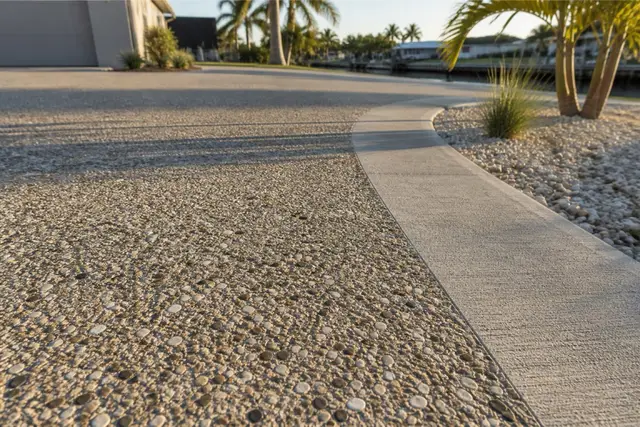
Cape Driveway Pros pairs Cape Coral homeowners with a local concrete contractor who quotes and handles exposed aggregate driveways across Cape Coral and its Lee County neighbors.
Exposed aggregate flips concrete inside out: the crew pours a mix seeded with decorative stone, then washes or retards the top layer of cement paste so the gravel itself becomes the wearing surface. The result suits Southwest Florida almost suspiciously well — tan and gray river rock with the occasional pale shell fragment looks native to a city built on shell fill, and the pebbled texture grips wet feet and tires through every afternoon storm.
Durability is the quiet argument for it here. The exposed stone shrugs off ultraviolet fade that flattens colored finishes, hides the fine white dust that settles off rock landscaping, and doesn't show tire marks the way smooth gray broom finish can. Salt-tolerant, too, in the sense that the hard aggregate takes the surface abuse canal-side lots dish out, with the cement paste protected below.
Cost runs between the workhorse and the showpiece: roughly $8 to $14 per square foot installed in this market, depending on the stone selected and how much of the driveway gets the treatment. A popular Cape configuration pairs an exposed-aggregate field with smooth troweled or broom-finished border bands — crisp lines at the garage and street, texture everywhere the tires live. Every option arrives priced separately on the quote.
Getting the wash right in Gulf heat
Exposure depth is the make-or-break variable: wash too early or too deep and stones pop loose for years; too late or too shallow and the surface reads as dirty concrete rather than decorative stone. Heat compresses the working window dramatically, which is why local crews pour at first light and lean on surface retarders to hold the top layer workable while the slab below sets. The technique sits squarely in the finishing practice the American Concrete Institute documents for hot-weather work.
The aggregate itself deserves a deliberate choice. Rounded river gravels in the three-eighths to five-eighths range feel best underfoot and release cleanly in the wash; crushed stone gives sharper sparkle but a toothier surface. Ask to see a washed sample panel wet and dry — the surface changes character completely in the rain, which around here it will meet regularly.
Sealing the surface without drowning the texture
An exposed surface has more area than a flat one, and the paste between stones is where weather gets its grip, so sealer earns its keep — but application technique matters more than on any other finish. Flooding the surface ponds sealer in the valleys and leaves glossy puddled spots; the right approach is thin coats that follow the contours. The National Ready Mixed Concrete Association's producer literature covers sealer chemistry; the discipline is in the roller work.
Maintenance after that is nearly boring. A rinse when the shell dust builds up, a re-seal every few years, and attention to one Cape-specific habit: keep well-water irrigation from running across the surface daily, because iron staining that wipes off a smooth slab likes to lodge in a textured one. The UF/IFAS Lee County extension office is the local authority on managing that iron-heavy irrigation water at the source.
Worth a deeper look
Before you pour
Does exposed aggregate hurt to walk on barefoot?
With rounded pea gravel to five-eighths stone, no — it feels like a textured path, not gravel road. Crushed angular stone is sharper underfoot. If the driveway is also the barefoot route from the pool to the garage fridge, say so at the sample stage and the stone choice will follow.
Do the stones come loose over time?
A properly proportioned and washed surface loses almost none — each stone is anchored most of its depth in the slab. Pop-outs point to over-washing at installation or a weak mix, both avoidable. The occasional single stone lost over years fills invisibly with a dab of matching epoxy.
Can I choose the stone colors?
Yes — local batch plants stock a handful of decorative aggregates from warm tans to salt-and-pepper granites, and the mix can blend them. Sample panels beat catalog photos every time; wet the sample before deciding, since rain deepens every tone on this coast for half the year.
Is exposed aggregate stronger than regular concrete?
The slab is the same engineered pour underneath; what changes is the wearing surface, where hard stone takes the traffic instead of cement paste. In practice that makes the surface more abrasion-tolerant — a real perk for boat trailers and the sandy grit that rides on every Cape tire.
How does it handle pressure washing?
Well — it's one of the easiest finishes to keep clean. Use a fan tip at moderate pressure and keep the wand moving; a zero-degree tip held close can scour paste from between stones. Most owners here just rinse with the hose and pressure-wash annually before resealing checks.