 Cape
Cape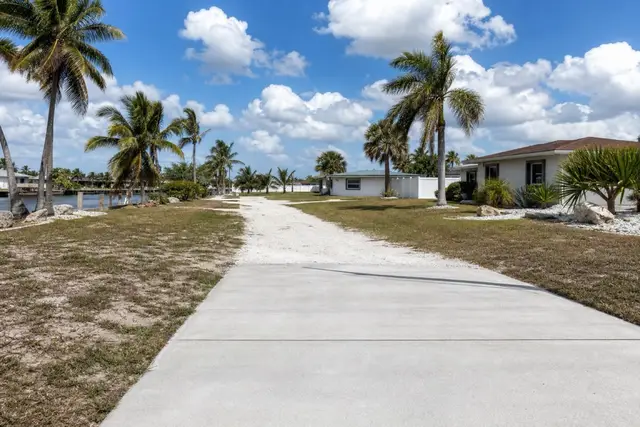
Cape Driveway Pros pairs Cape Coral homeowners with a local concrete contractor who quotes and handles gravel-to-concrete driveway conversion across Cape Coral and its Lee County neighbors.
Drive the Cape's older northeast blocks, North Fort Myers, or Pine Island and you'll still pass plenty of white shell-rock driveways — the original surfacing of old Southwest Florida. They're charming until you live with one: summer storms cut ruts and wash fines into the swale, dry season turns the surface to dust that powders every car, weeds colonize the edges, and every couple of years a fresh load of shell has to be spread and graded just to hold position.
Conversion turns that maintenance treadmill into structure. The existing shell hands the project an unearned advantage: decades of tires have already compacted it into a respectable base layer. The crew regrades it, tightens it further with a plate compactor, builds up any washed-out low spots, then forms and pours a reinforced slab over ground that has already proven it can carry traffic.
The payoff list is long for one project: no more ruts or regrading, a clean surface that doesn't migrate into the lawn, real curb appeal on streets where concrete is becoming the norm, and — no small thing in this market — the finished, maintained look buyers expect. Conversions price like new installation, roughly $6 to $10 per square foot, minus the excavation a virgin lot would need.
Why shell drives fight the drainage system
Loose surfacing and Cape Coral's engineered drainage are natural enemies. Every hard rain carries shell fines and gravel off the driveway and into the roadside swale, gradually flattening the grade the stormwater system depends on — one reason the city's Surface Water Management division cares about what surfaces meet the right-of-way. A concrete drive with a properly pitched apron sends clean sheet flow to the swale and keeps its aggregate to itself.
The conversion moment is also when the apron gets brought up to current standards — including a culvert pipe where your frontage carries flow. If your shell drive predates modern permitting — common on the Cape's oldest blocks and on unincorporated lots that answer to Lee County Community Development instead of the city — expect the contractor to square that away as part of the job; it's routine, and it beats discovering the issue during a future sale's inspection.
Building on a base that traffic already proved
There's a quiet engineering advantage buried in an old shell driveway: decades of wheel loads have done slow-motion compaction that no machine fully replicates. Crushed shell and sand lock together well — it's why the material surfaced roads across early Florida — and as a confined base under a slab it performs beautifully. The general principles of base preparation over sandy soils track the state's soil character described in UF/IFAS's Agricultural Soils of Florida.
The exceptions get handled, not ignored: organic-stained edges where grass crept in get cut out, rutted wheel paths get filled and re-rolled, and any spot that pumps underfoot after rain gets dug and rebuilt. An hour of probing tells the crew which driveway they're standing on — the proven base or the pretty crust — and honest quotes are written after that hour, not before.
Worth a deeper look
Before you pour
Can concrete be poured right over my gravel driveway?
Close to it. The existing shell or gravel becomes base material, but it gets regraded, compacted, and trued up first rather than poured on as-is. Surface organics and soft edges come out. That prep day is the difference between using the old driveway and merely burying it.
Will conversion change my drainage?
It formalizes it. Rain that used to soak unevenly through gravel will sheet off concrete, so the pour is pitched to send that water to the swale, not your garage or your neighbor. On lots where the swale carries flow, a culvert under the new apron keeps the street system working.
What does converting a long rural drive cost?
Length is the multiplier — a 150-foot Pine Island ribbon is a different project than a 40-foot city drive. Ribbon-style construction, two concrete runners with grass or shell between, converts long drives at a fraction of full-width cost and suits the old-Florida look many island owners want to keep.
How long does a conversion take?
Typical city lots: two to four working days — regrade and compact, form, pour, then cure before the barricades come down. Long rural drives scale up with footage. Vehicles stay off about a week after the pour, so plan street or side parking for that stretch.
Is a shell driveway grandfathered, or will a sale force this anyway?
Shell drives remain common and legal on many older lots, but buyers and lenders increasingly flag them, and any apron work triggers current right-of-way standards. Converting on your schedule — rather than during a rushed closing — is the version of this project where you control the choices.