 Cape
Cape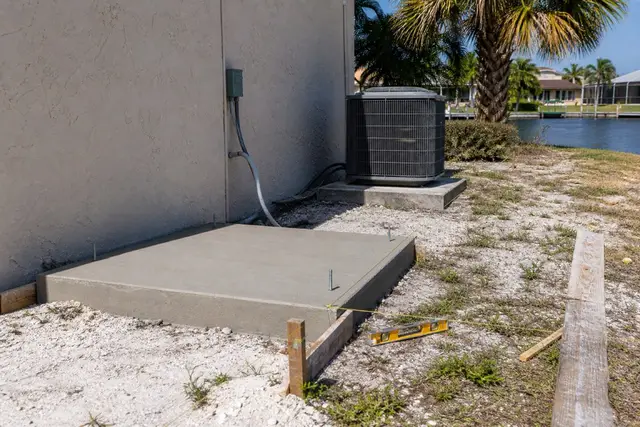
Cape Driveway Pros pairs Cape Coral homeowners with a local concrete contractor who quotes and handles concrete slabs & pads across Cape Coral and its Lee County neighbors.
Every Cape Coral property runs on small rectangles of concrete nobody photographs: the pad under the AC condenser, the reinforced slab a standby generator bolts to, the shed floor, the pad behind a storefront where the dumpster lives. Small pours, but they carry equipment that costs multiples of the concrete — and in a hurricane-prone county, several of them double as anchor points that inspectors and equipment manufacturers take seriously.
Generator pads have become their own local specialty. After Hurricane Ian left much of Lee County dark, whole-home standby generators went from luxury to common upgrade, and each one needs a level, engineered pad sized to the unit, poured with anchor bolts or sleeves placed to the manufacturer's template, and elevated enough to keep the machine dry when the yard sheets with stormwater. The same logic covers pool-equipment pads and mini-split stands.
Commercial slab work scales the category up: interior floors for small shops, walk-in cooler pads, loading areas, and equipment housekeeping pads with curbs. Thickness, reinforcement, and finish get specified to the load — a 4-inch fiber slab for a shed, six inches with rebar for a dumpster pad that meets a garbage truck's front forks twice a week. Each quote states its spec plainly.
Pads that hold equipment through a storm
Florida's wind rules changed what a humble pad has to be. Condensers and generators are strapped or bolted against uplift, and the anchors are only as good as the concrete they grip — thickness, edge distance, and cured strength all show up in the fastener math. The engineering culture behind those requirements is visible in the National Hurricane Center's Ian report: equipment that stayed put was equipment that was anchored to something real.
Elevation is the second half. Yards here are graded to move sheet flow toward swales, and a pad poured flush with grade sits in that flow twice a summer week. Local practice raises equipment pads several inches proud of the lawn — cheap insurance for machines that hate wading. Permitting for generator installations routes through the city or Lee County Community Development depending on your address; the trades coordinate it as part of the install.
Getting small pours taken seriously
The industry joke is that nobody wants to send a truck for a yard and a half of concrete — but small-batch pours are a real logistics category, handled with short-load mixes, on-site trailers, or scheduling the pad onto a day when a bigger pour is already in the neighborhood. The producers behind those options are the membership of the National Ready Mixed Concrete Association, and a contractor who pours here weekly knows which plant answers the small-load phone.
Specification discipline stays full-sized regardless of square footage: compacted base even under a 3-by-3 pad, mix strength matched to the duty, anchor hardware set in the wet pour rather than drilled as an afterthought where the template allows. The fundamentals live in the Portland Cement Association's concrete literature — small slabs fail for the same reasons big ones do, just cheaper.
Worth a deeper look
Before you pour
How big should a generator pad be?
The unit's footprint plus the manufacturer's required clearances — typically a few inches of pad beyond the frame on all sides, with anchor points matching the template in the install manual. The electrician and the concrete crew work from the same spec sheet; that coordination is part of the job.
Can a shed sit on a plain 4-inch slab?
Most yard sheds, yes — a fiber-reinforced 4-inch slab over compacted base with a thickened edge handles typical storage loads. Larger workshops, lifts, or anything with point loads step up in thickness and steel. Tell the quote what's going inside; the spec follows the contents.
Why did my old AC pad sink on one side?
Almost always base washout — a downspout, a dripping condensate line, or sprinkler flow slowly moved the sand out from under one edge. Small pads can often be lifted and releveled; the durable fix also reroutes the water that caused it. New pads here get set proud of grade to stay out of sheet flow.
What does a dumpster pad need that a patio doesn't?
Mass and steel. A garbage truck's front forks put concentrated load exactly where the container sits, so commercial dumpster pads run six inches and up with rebar mats, often with an approach apron to protect the asphalt in front. It's a truck-duty slab wearing a utility name.
Do small pads need permits?
Frequently the equipment does even when the concrete alone wouldn't — generators and mechanical changes carry their own permitting through the city or county, and the pad is inspected as part of that package. Freestanding shed slabs depend on size and zoning. The contractor confirms your address's answer before pouring.