 Cape
Cape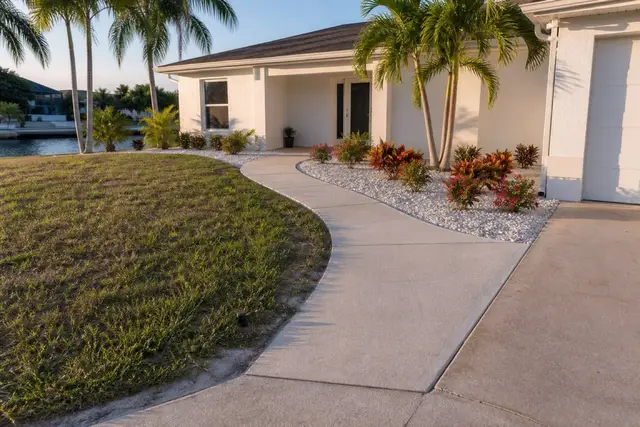
Cape Driveway Pros pairs Cape Coral homeowners with a local concrete contractor who quotes and handles concrete walkways & sidewalks across Cape Coral and its Lee County neighbors.
The walkway is the handshake of a Cape Coral house: the path that carries every guest from the driveway to the front door, past the crotons and the white-rock beds. Pouring one well is small-scale work with full-scale standards — excavate the turf line, compact the sandy base, form the curves, and finish with a fine broom so summer rain never turns the route slick. Four feet of width lets two people walk it together; three and a half is the comfortable minimum.
Curves cost almost nothing in concrete, which makes them the Cape's best landscaping bargain. A walk that sweeps around a royal palm or arcs past a clusia hedge reads as designed rather than installed, and flexible form board bends to any radius the yard wants. Add a tooled or stamped border band and the path picks up a finished edge that mulch and rock beds can meet cleanly.
Sidewalk work rounds out the category: replacing heaved or cracked public-sidewalk sections in front of older lots, tying new walks into existing driveway slabs with proper isolation joints, and pouring pool-gate paths and side-yard utility routes where trash cans roll. Small pours, honest prices — walkway projects commonly land in the four figures, quoted per square foot with prep itemized.
Roots, palms, and routing a path that stays flat
The classic sidewalk destroyer — shallow-rooted shade trees heaving panels — is mercifully rare in Cape yards, because palms dominate and palm root systems behave: thousands of pencil-thin roots instead of trunk-like heavers, which is part of why they're the region's default street tree. The University of Florida's guide to ornamental palms for South Florida covers root habits and sensible planting distances. Broadleaf exceptions — ficus above all — deserve wide berth or root barriers.
Where a route must pass close to an established tree, the answer is design, not surgery: float the path over the root zone on a thickened edge, narrow it briefly, or curve it away. Cutting structural roots to force a straight line trades a flat sidewalk today for a stressed tree and a lifted slab in five years.
Small pours, real specifications
Walkways get poured at four inches over compacted base in this market — the same section as a driveway, minus the vehicle loads — because thin three-inch paths crack at the first landscaping tractor or loaded wheelbarrow. Joint spacing tightens to match the width, roughly every four to five feet, so shrinkage shows up as clean tooled lines instead of wandering cracks. The fundamentals are textbook flatwork, well covered by the Portland Cement Association.
Drainage thinking scales down but doesn't disappear: paths get a slight cross-pitch so they shed rather than pond, and a walk crossing the front yard shouldn't dam the sheet flow the lot's grading depends on — a genuine consideration on a coast where the National Weather Service logs summer storm totals that arrive an inch at a time. Step-downs at patio and entry thresholds keep splash away from stucco and door sills.
Worth a deeper look
Before you pour
How much does a concrete walkway cost?
Priced by the square foot like all flatwork — typically in the installation range for plain broom finish, with curves adding little and decorative borders or stamping adding per-foot upcharges. A standard 4-by-30 front walk usually lands comfortably in the four figures, itemized.
Who owns the sidewalk in front of my house?
In most of Cape Coral the strip along the street sits in public right-of-way, and repairs there involve the city's permitting. Interior walks are entirely yours. The contractor works out whether your path crosses that boundary and pulls whatever the public portion requires.
Can a new walkway match my existing driveway?
Closely. Matching the broom texture and joint styling does most of the work, and the tone difference between new and older concrete fades over a year or two of sun. A deliberate contrast — a stamped border walk against a plain drive — is equally valid and hides the age gap entirely.
Do walkways need reinforcement?
Fiber-reinforced mix is standard and sufficient for foot traffic; steel enters the picture where a path doubles as a cart or mower route. Base compaction matters more than steel at this scale — on the Cape's sand, a well-compacted four-inch path outlasts a poorly based six-inch one.
When can a fresh walkway take foot traffic?
Light foot traffic after about 24 hours, normal use in two to three days, and give it the full week before wheeling anything heavy across. Florida heat accelerates early strength, but edges and tooled details appreciate the extra patience.