 Cape
Cape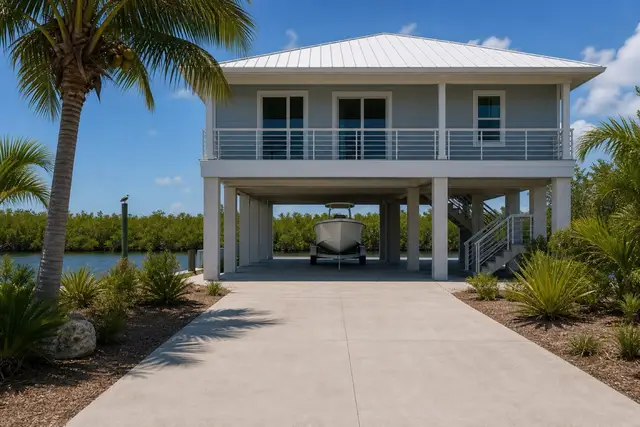
Cape Driveway Pros pairs St. James City homeowners with a local concrete contractor who covers St. James City for new driveways, tear-out replacements, repairs, and decorative concrete.
St. James City holds down Pine Island's southern tip — 3,876 people counted in the 2020 Census, the bulk of them settled along a fan of dredged canals that give the community its identity: boat-first households where the vessel under the stilt house matters more than the car beside it. Canals here run to Pine Island Sound in minutes, and the real estate is organized entirely around that fact.
The concrete that serves this lifestyle is specific: drives leading to elevated homes, slabs beneath stilt houses where boats and trucks shelter, trailer pads built for tandem axles and daily salt drip, and approaches that handle a truck-and-trailer turning radius on narrow island streets. Surface finishes stay practical — broom texture that grips boat-ramp-wet shoes beats anything decorative down here.
Ian hit this end of the island hard in 2022, and the recovery has been slab by slab: elevated replacement homes with new under-house concrete, repaired seawall caps, re-poured drives where surge scoured bases. Cape Driveway Pros routes St. James City work to a contractor who knows the south-island drill — small streets, salt everywhere, and owners whose wish lists got very specific the hard way, during the rebuild.
The trailer pad as primary infrastructure
In St. James City the boat pad outranks the driveway: it carries the household's most valuable rolling load, takes a saltwater rinse every time the boat comes home, and doubles as hurricane tie-down ground when the Gulf gets busy. Building it right means five-plus inches of reinforced concrete, compacted base, cast-in anchor points where owners want them, and pitch that sends washdown brine away from the house — durability logic straight from the marine-exposure playbook the American Concrete Institute maintains.
Storm rules from Lee County govern what stands where on these flood-mapped lots, and the National Hurricane Center's Ian report is the reason nobody down here argues with them anymore. Concrete that respects the flow paths survives; concrete that dams them becomes debris.
Canal-lot ground at the island's end
South-island lots blend native sand over limestone with dredged canal fill along the waterfront — ground that drains fast and compacts well but varies within a single lot, especially where old fill meets native grade. Slab work here starts with probing both zones; the sandy-soil behavior underneath is the statewide story UF/IFAS tells in its Florida soils publication, with the island twist of caprock never far below.
Seawall adjacency is the other constant: much of the community's concrete sits within a few dozen feet of a wall holding back a canal. Keeping new slab loads and concentrated runoff clear of tieback zones, and coordinating flatwork with any seawall repair, is standard sequence — the wall gets fixed first, the concrete follows. Weather windows for all of it run through the NWS Tampa Bay forecast like everything else on this coast.
Worth a deeper look
Before you pour
Can you pour a slab under my existing stilt house?
Usually yes — under-house slabs are placed with pumps and short chutes around pilings, designed as flood-tolerant parking and storage surfaces per the county's floodplain rules. Clearance, access, and what the space will hold determine the spec; the site visit measures all three.
What should a boat pad cost in St. James City?
Sized for a typical bay boat and trailer, most land in the low-to-middle four figures depending on thickness, anchors, and how much base build-up the spot needs — island haul included. The quote itemizes those pieces so the number explains itself.
My drive washed out at the seawall end during Ian — what's the fix?
Rebuild the base where surge scoured it, verify the seawall and its backfill are sound first, then repour with the slab kept clear of the wall's working zone. Doing the concrete before the wall check is the classic expensive mistake — the right order costs nothing extra.
Is broom finish really the best choice here?
For working waterfront lots, almost always — maximum wet traction, easiest repair, no sealer-gloss slip worries with ramp-wet feet. Owners wanting more look typically put a stamped border at the street and keep the working surfaces broom. Function first is the island aesthetic anyway.
How far out do island pours get scheduled?
Routine jobs typically land within a few weeks, with island runs grouped for efficient concrete hauls over the causeway. Storm season can shuffle specific pour days — the schedule bends to the radar, and the contractor communicates dates rather than leaving you guessing.