 Cape
Cape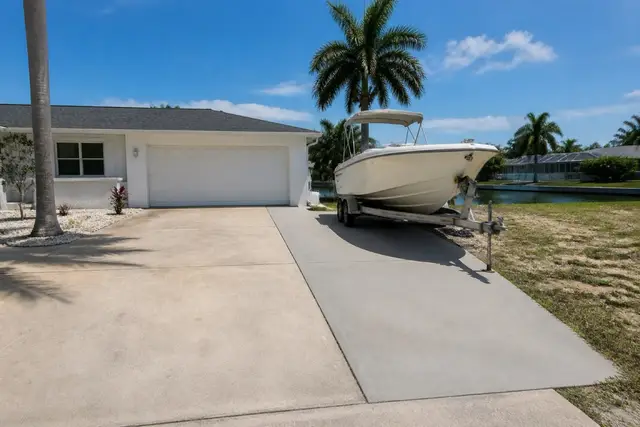
Cape Driveway Pros pairs Cape Coral homeowners with a local concrete contractor who quotes and handles concrete driveway extensions across Cape Coral and its Lee County neighbors.
Cape Coral households collect vehicles the way coastal towns do: a truck for work, a second car, a boat on a trailer, sometimes a golf cart with its own parking spot. The original driveways on quarter-acre Cape lots — often a single-car ribbon or a narrow double — were never sized for that fleet, and grass parking on Bahia sod turns to ruts and sand patches by the end of one wet season. An extension pours new legal, mud-free parking alongside what you already have.
The craft is in the connection. A good extension gets doweled into the existing slab with epoxied steel pins so the two pours move as one instead of shearing apart at the seam, sits on base compacted to match, and picks up the original's joint pattern so the addition looks planned rather than bolted on. Expect the new concrete to read brighter for a year or two before Gulf sun evens the tones out.
Extensions also trip smaller regulatory wires than owners expect: lot-coverage percentages, setbacks from side lines, and — if the widening touches the apron — the same right-of-way approval as any driveway work. None of it is difficult for a contractor who pours in the city weekly, and the quote spells out the permitted square footage before anything gets formed.
Sizing a pad for the boat
The math on trailer parking is unforgiving: a 22-foot bay boat on a trailer wants roughly 30 feet of length once you count the tongue, and tandem axles concentrate weight in a small patch. A strip meant to hold one deserves five or six inches of concrete over well-compacted base rather than the four inches a car needs. In a city where the canal system puts a boat behind a remarkable share of houses, this is the most-requested extension on the books.
Placement matters as much as thickness. Keeping the pad clear of the side-yard drainage path, pitching it a quarter inch per foot away from the house, and leaving the swale frontage undisturbed keeps the addition friendly with both your foundation and the city's stormwater rules, which the Surface Water Management division enforces at permit time.
Making two pours act like one slab
Concrete's enemy at a cold joint is differential movement — the new pour settling a hair while the old slab stays put, leaving a lip that catches trailer jacks and toes. The standard defense is doweling: holes drilled into the existing edge, deformed bars epoxied in, the new pour locked around them. Jointing and load-transfer practice is core curriculum in the American Concrete Institute's Topics in Concrete library, and it's the difference between a seam you forget and one you trip on.
The subgrade deserves equal respect. The extension strip usually goes where lawn stood for decades, and turf root zone compresses differently than the sixty-years-settled fill under the original drive. Stripping the organics, building up clean fill, and compacting in lifts brings the new ground to parity — skip it, and the seam will report the shortcut within a couple of wet seasons.
Worth a deeper look
Before you pour
Can I park my boat trailer on the lawn instead?
You can, but Bahia grass over sand loses that fight fast — ruts in the wet season, bare patches by fall, and tires that sink to the axle after a week of storms. A doweled concrete strip costs real money once, then ends the annual re-sodding cycle. Many owners split the difference with a ribbon-style pair of runners.
Will an extension look obviously newer than my driveway?
For the first year or so, yes — new concrete cures gray-white while your original slab has decades of sun bleaching. The tones converge over time. Matching the broom direction and continuing the existing joint lines does more for a seamless look than any coloring trick.
How wide can my driveway legally get?
Cape Coral caps driveway coverage through zoning rules on lot coverage and apron width at the right-of-way, and the numbers differ by lot type. Interior widening is usually generous; apron widening gets more scrutiny because of the swale. The contractor confirms your lot's allowance before quoting square footage.
Do extensions need their own control joints?
Yes. The new strip gets joints sawn to match the spacing logic of the original slab — roughly in feet, two to three times the slab thickness in inches — and a full-depth isolation joint wherever it meets the house, a pool deck, or other fixed structures. Concrete shrinks; joints decide where.
What does a typical widening cost?
Priced like new installation — commonly $6 to $10 per square foot around Lee County — plus the doweling work at the seam. A 10-by-30 third-car strip generally lands in the low four figures. The itemized quote separates base, slab, and connection so you can see each piece.