 Cape
Cape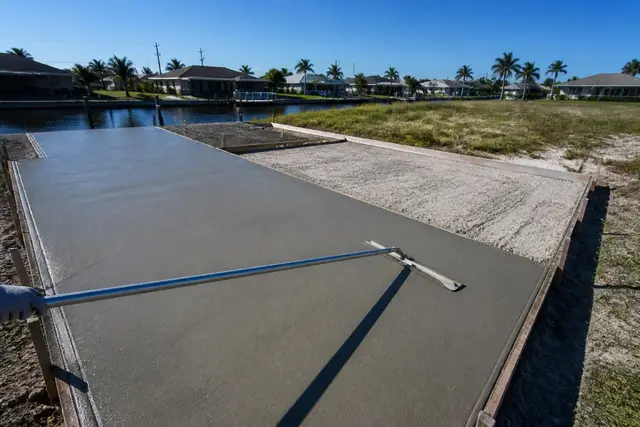
Cape Driveway Pros pairs Cape Coral homeowners with a local concrete contractor who quotes and handles concrete driveway installation across Cape Coral and its Lee County neighbors.
Almost every driveway in Cape Coral gets poured on ground that didn't exist a lifetime ago. The city sits on pale sand-and-shell fill pumped out of its own canals in the 1960s and 70s, raised to roughly five and a half feet above sea level before the first houses went up. That fill drains beautifully, but it settles if nobody makes it behave — so a proper installation starts with proof-rolling the subgrade, tightening it with a plate compactor, and only then setting forms.
The pour itself follows a hot-climate script. Trucks arrive early, often by seven, because a slab surface can flash-dry under the Cape's high sun before the finishers get their broom on it. Four inches of 3,000 PSI ready-mix is the residential floor here, with fiber or welded wire holding shrinkage cracks tight, and the crew saws control joints the same day rather than waiting for hairlines to pick their own path.
Money-wise, plain broom-finished installation around Lee County generally runs $6 to $10 per square foot, with the compacted subbase adding a dollar or two where fill needs building up. A typical two-car drive lands in the mid four figures. The contractor Cape Driveway Pros pairs you with walks the lot, measures the run from garage to street, and returns an itemized number — base, slab, and finish each on its own line.
What dredged fill asks of a new slab
Soil scientists classify most of Southwest Florida's native ground as deep, sandy, and low in clay — the state's flatwoods soils are profiled in the University of Florida's Agricultural Soils of Florida publication — and the Cape's man-made fill behaves like an exaggerated version of it. Water passes straight through, which spares driveways the heaving that clay country suffers, but loose pockets left over from the original dredging can compress under a slab years later.
That's why the unglamorous half of installation matters most. A crew that compacts in lifts, wets the sand to help it seat, and re-rolls soft spots is buying you decades; one that screeds over fluffy fill is scheduling your future repair. The city's own account of how the ground got here is worth a read — Cape Coral's canal dredging program still maintains the 400-mile system the fill came out of.
The permit between your garage and the street
In Cape Coral, the last few feet of a new driveway cross public right-of-way, and the city treats that crossing seriously because it doubles as the neighborhood's drainage. Every lot fronts a graded swale, so the city's Surface Water Management division issues and inspects driveway permits and classifies each apron as a swale, ramp, or culvert driveway depending on how water moves across your frontage.
On culvert lots, a pipe goes under the apron so the swale keeps flowing; on swale lots, the apron dips with the grade. Homeowners outside city limits deal with Lee County Community Development instead. Either way, the contractor folds the permit and its inspections into the quote — it's routine for anyone pouring here weekly, and a red flag if a bidder shrugs it off.
Worth a deeper look
Before you pour
How thick should a new driveway be in Cape Coral?
Four inches is the standard for cars and pickups on a properly compacted base, stepping up to five or six inches at the apron, on RV pads, or anywhere heavier loads will sit. On the Cape's sandy fill, added thickness never substitutes for compaction — the ground prep and the slab work as a system.
Does new construction need a culvert under the driveway?
It depends on your frontage. Cape Coral classifies each apron as a swale, ramp, or culvert driveway based on how stormwater moves along your street. If your lot's swale carries flow, a pipe goes under the apron and the permit covers its size and placement. The contractor sorts this out during the site visit.
What finish holds up best under Florida sun?
A medium broom finish is the workhorse: it sheds water, keeps traction through summer downpours, and shrugs off ultraviolet fade better than smooth troweled surfaces, which can also become slick when wet. Decorative options like stamping or exposed aggregate hold up well too when sealed on schedule.
How soon after closing on a new build can the driveway go in?
Once final grade is set and utilities are trenched and backfilled, the driveway is usually one of the last exterior items. On in-fill lots the timeline mostly hinges on the right-of-way permit and culvert work; the pour and finish themselves are typically a one-day affair, plus cure time.
Is wire mesh or fiber better in the slab?
Both control shrinkage cracking; neither turns a bad base into a good one. Fiber mixes cost a bit less and can't be left lying at the bottom of the pour the way poorly chaired mesh can. Many local contractors quote fiber as standard and mesh or rebar where aprons and pads carry more weight.